
The 250th Anniversary of the State Academic Bolshoi Theatre of Russia
Obverse
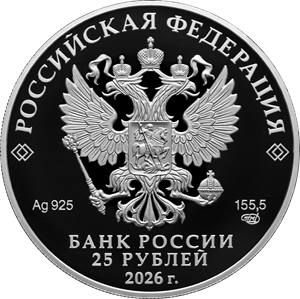
a relief image of the National Coat of Arms of the Russian Federation, above it along the rim the inscription in a semicircle ‘РОССИЙСКАЯ ФЕДЕРАЦИЯ’ (RUSSIAN FEDERATION) framed with paired diamonds on both sides, under the coat of arms on the left the chemical symbol and fineness of the metal and on the right the fine metal content and the mint mark, at the bottom centre in three lines the inscription ‘БАНК РОССИИ’ (BANK OF RUSSIA), the coin denomination ‘25 РУБЛЕЙ’ (25 RUBLES), and the year of issue ‘2026 г.’ (2026).
Reverse
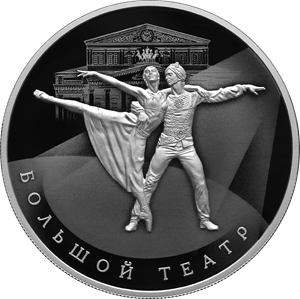
a relief image of a dancing ballet couple against the background of the images of the building of the Bolshoi Theatre and spotlights, laser treated for matte finishing, and the inscription ‘БОЛЬШОЙ ТЕАТР’ (BOLSHOI THEATRE) around the lower circumference.
Authors
Designers: E.V. Kramskaya (obverse), A.A. Brynza (reverse).
Sculptors: A.A. Dolgopolova (obverse), A.N. Bessonov (reverse).
Mint: Saint Petersburg Mint.
Edge: 252 corrugations.
Discover more
The Bolshoi Theatre was originally established as a private theatre owned by provincial prosecutor Prince Pyotr Urusov. On 28 March 1776, Empress Catherine II granted him the privilege ‘to be the owner of all theatrical performances in Moscow’ for a ten-year period. This day is considered to be the date of the foundation of the Bolshoi Theatre. However, the building that has long been regarded as one of Moscow’s main landmarks was completed many years later.
The building of the Petrovsky Theatre, named for its location in Petrovka Street, was constructed in just five months, but was then destroyed by fire in 1805.
In 1819, the authorities announced a competition for the design of a new building for the theatre, which was won by Andrei Mikhailov, professor of the Academy of Arts. His project was later on revised by Joseph Bové. The grand opening of the new Petrovsky Theatre, which was much larger than the destroyed old building and therefore named the Bolshoi Petrovsky Theatre, took place on 18 January 1825. The façade of the building was decorated with a portico of eight white-stone columns and a statue of Apollo in a chariot drawn by a trio of horses on the building’s gable.
After the fire of 1853, which continued for three days and destroyed everything around, Alberto Cavos, chief architect of the Imperial Theatres, began to restore the theatre. Although Bové’s columned porticoes were preserved, the main façade notably altered. Apollo’s trio of horses was replaced with a quadriga designed by Russian sculptor Peter Clodt von Jürgensburg. Alberto Cavos paid particular attention to the theatre auditorium designed as a huge musical instrument. In the second half of the 19th century, the Bolshoi Theatre was regarded as one of the best ones in the world in terms of its acoustics. The restoration progressed very quickly, and the theatre reopened in Moscow in August 1856.
Today, the Bolshoi Theatre is the cultural landmark of the capital and is one of the main theatrical venues around the globe. The theatre comprises an opera company and a ballet company, a brass band, and the Bolshoi Orchestra. The theatre is the venue where such maestros as Irina Arkhipova, Yuri Grigorovich, Ivan Kozlovsky and Yevgeny Svetlanov, as well as world-famous ballerinas Galina Ulanova, Maya Plisetskaya and Marina Semyonova worked and gained recognition.
Sources: https://bolshoi.ru, https://www.culture.ru